Personal Finance for Tech Professionals
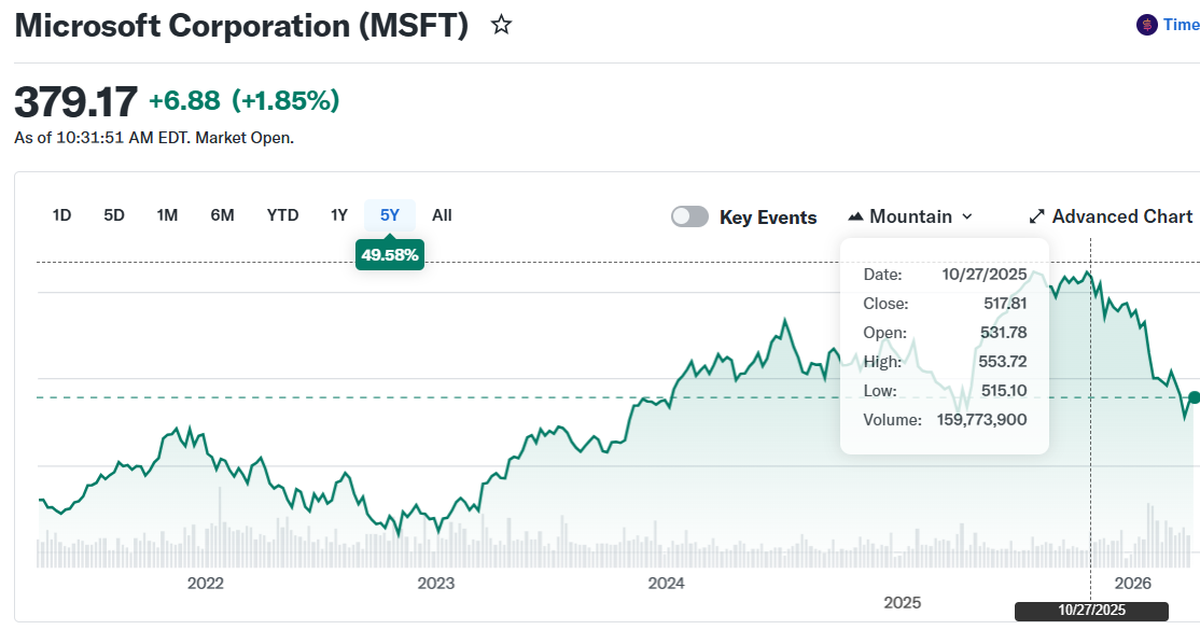
This post contains content from a talk I gave to my ex-Microsoft colleagues in April 2026. It covers how I managed my personal finances and stock compensation earned during my 10+ years at the company. While I hold credentials in financial planning, this is a personal sharing — not professional financial advice.
I joined Microsoft when the stock price was still in the double digits. This led to an interesting problem — and because it's a "rich man's" problem, it's hard to talk about.
Microsoft stock (not salary) made me feel very rich. And if you've been earning MSFT stock awards long enough, it likely made you feel very rich too — well, at least very rich on paper. But here are the problems:
- The vast majority of my wealth was in Microsoft stock — on paper
- Because it helped boost my wealth so quickly, I don't want to sell a single share
- Even if I sell, I don't know what to do with it!
- And now that it's down significantly, I don't want to sell either.
If you think about it — when are you ever going to sell?
You probably never will, unless some crisis forces you to.
Today's Three Questions
Disclaimer: This is a personal sharing. While I have certain credentials in financial planning and management, I don't practice it professionally. This talk is highly opinionated.
When Is Enough, Enough?
Well, how much does your comfortable lifestyle cost?
- Use an app to track your monthly/yearly income and expenses
- Create spreadsheets to break down your expenses and truly understand where the majority of your money is going
In corporate finance, there are 3 key financial statements: balance sheet, income statement, cash flow statement. For personal finance, the most important (in my opinion) is the cash flow statement.
Define Your "Living Standard"
Form a perspective — how much does your target comfortable lifestyle cost?
- How much does your family want to spend on daily necessities per month (including dining out)?
- How much does your family want to spend on international travel per year?
- How much do you want to splurge on other things per month/year?
I call this my target "living standard." Once you articulate this, COMMIT.
Monthly Living Standard × Months to Get Active Income AgainMonthly Living Standard through investments aloneBut while you haven't achieved it, be wise. Keep your emergency fund amount liquid, invest the rest. (I wrote a 5-part personal finance basics series in 2019 that covers these foundations in more detail — including emergency funds, financial goals, and amateur investing.)
Start thinking about monthly cash flow.
Where & How Should We Invest?
Well, I can't really decide for you and tell you where.
But here's the thing — you can expand your circle of competence. And the single best investment you'll ever make isn't a stock or an ETF. It's in yourself.
Practical Ways to Invest in Yourself
- 1Know how you learn bestBooks or ebooks? Certification course? YouTube videos? Learning by doing? Or a combination of many things?
- 2Invest real money in learningWhen I need to learn something difficult, I intentionally look for things that cost me money. As the Bible says, "Where your treasure is, there your heart will be also" (Matthew 6:21). This meant enrolling in a paid financial certification course and setting aside a significant amount to trade in the stock market. I prefer losing real money over playing with demo accounts.
- 3Use GenAI to your advantageMany of you have been telling customers how GenAI can craft training plans and accelerate learning — but do you actually use it yourself?
- 4Network and find mentorsSimilar to how we network for our careers, we need to do the same for personal finance. It's harder — you need to find the right people you can trust and share details with. But I would argue that financial networking is more important than career networking.
- 5Create a financial plan, not just a career planIn Microsoft, we are very used to creating a career plan. Honestly, I always struggled with those. I told many people: "I might not have a strong career goal and plan, but I have a strong financial goal and financial plan."
Take Action
We're all smart people in this room. Technical sellers. We read. We analyze. We know the world is changing. But knowing and doing are different things.
Learn to take some risks. When you find good things to invest in, go for it. Leaving MSFT stock in Fidelity feels safe. It's familiar. MSFT always goes up, right?
But MSFT is not a "safe" stock — it's a blue-chip tech stock, and that still carries real risk. Don't be ignorant of its risk level. Face the risk and form your risk appetite.
How Much Do We Invest?
If you're just learning, invest in small steps.
But if you've understood the investment, be bold. Your existing assets (emergency fund, insurance policies, active regular income) are your foundations — even if you lose money, so what?
The Gemini Story
Last November, Google announced Gemini 3. When it was announced, many people debated which was better — Gemini 3 or OpenAI GPT 5.1. The information was available to everyone. And with Copilot, everyone could understand the business forecasts and impact more easily.
Probably nothing. Held the stock and hoped for the best.
This is called HODL
"Hold On for Dear Life"
↓ 30%
if left everything in MSFT
Rebalanced my portfolio. Diversified into other large-cap tech and growth sectors.
Same information, same tools, different action.
↓ 5–10%
during the current war situation
You all have access to the same information as most people. You know how it is affecting tech stock prices, oil prices, and gold prices — you have a lot of MSFT stock, you know it's concentrated, you've probably thought "I should do something with this."
The question is: will you?
Own the decision, and whether good or bad, own the results.
What Am I Personally Doing?
I've explored all of these to varying degrees — so far, everything has made money.
- 1Swing TradingUsing online brokerage platforms. Active trading based on market movements and technical/fundamental analysis.
- 2Monthly DCA of Select ETFsA mix of broad market index ETFs, S&P 500 ETFs, and gold ETFs. Dollar-cost averaging removes the pressure of timing the market.
- 3Robo-AdvisorsThere are many robo-advisor platforms available today that offer low-effort, diversified portfolio management. Research what's available in your country.
- 4Investment Options from Your Bank(s)Investment funds: BlackRock, iShares, etc.
Structured products: Fixed-coupon notes, equity-linked notes, etc. (very high risk!) - 5GenAI as My Financial Sparring PartnerThis one deserves its own moment — because as people who work in tech, you're uniquely positioned to do this. See next page...
AI as a Financial Sparring Partner
I run an AI-powered "second brain" — a personal knowledge vault where an AI assistant helps me track, analyze, and act on financial information. Here's what that looks like in practice:
- 1Daily Situational UpdatesEvery morning, my AI searches the web for the latest on the Iran war, oil prices, gold prices, exchange rates, and geopolitical news — then updates my finance notes automatically. I wake up to a briefing, not a newsfeed.
- 2Scenario AnalysisI maintain "what if" scenarios with probability weights — the AI helps me reason through how each scenario affects my portfolio and what actions to take.
- 3Portfolio Strategy as a Living DocumentMy rebalancing plan isn't a static spreadsheet. The AI keeps it updated with market data, flags when triggers are hit, and reminds me of monthly actions.
- 4Research & LearningWhen I want to understand a new asset class, I use AI to explain concepts, compare options, and sanity-check my reasoning.
- 5Decision JournalingThe AI helps me capture why I made each decision, so I can review my thinking later — not just the outcome.
GenAI Demonstration
Claude Code CLI + a markdown vault on OneDrive = AI-powered second brain
AI doesn't replace your judgment. It amplifies it.
It handles the data gathering, the tracking, the reminders, the what-if calculations — so your brain is freed up for the actual decisions.
- Negotiated deal — 42% ↑↑↑
- Extended war — 25% ↓
- Stalemate — 12% ↓
- Regional — 10% —
- Full infra war — 8% ↓↓↓
- Peace — 3% NEW
My Call to Action
This is what I want you to walk away with today.
You already have access to Copilot and other AI tools through Microsoft.
Some of you have personal subscriptions to Claude Code and Cursor.
Use them — not just for building apps, but for your personal finances too.
Q&A + Closing
Quick Recap
For Those New to Investing: Top 3
- 1Know your cash flowTrack every dollar. Understand your spending. Define your living standard.
- 2Accelerate learning with AIYou already have the tools. Use them for your personal finances, not just work.
- 3Just start, then find the right peopleOpen a brokerage account. Buy your first ETF. Then find people you trust to talk about this with.